In popular culture, people talk about "returning to the good ol' days" when struggles in private lives and society cause us to want to reconnect with that time, or that beginning, when things were good. This need for periodic renewal is reflected in cycles of the universe, within ancient African culture, and in the annual cycle of harvest and renewal we celebrate as Kwanzaa.
In ancient Kemet, for example, the pursuit of periodic renewal to maintain or restore Maat was referred to as the pursuit of the "First Occasion" (the "Zep-Tepi") when truth, justice, balance, and harmony existed and the world was good.
As Dr. Tdka Maat Kilimanjaro explains in the introduction to his recent text titled, "Zep-Tepi," –
"In Ancient Kmtian thought, Zep Tepi ('the First Occasion') is one of the most layered and symbolically charged concepts in their cosmology, history, and political ideology. Its meaning shifts depending on the context – religious, mythological, political, and philosophical – but it always points to a primordial moment of ordering, when the universe, the gods, and human society were set in motion according to Maat (truth/order)."
He further explains this "is not simply 'the beginning' but the eternal pattern, a cyclical renewal that connects [and reconnects] humanity to divine order."
Zep-Tepi, then, is a process of "returning to the good ol' days" by which we restore ourselves, renew our institutions, and revive our societies and ways of living by reconnecting with the best of what has been lost from the beginning. We live in days where such a renewal is needed as recurring cycles of increased oppression and decreased opportunities negatively impact our people – with more to come.
In this moment, reconnecting with the Zep-Tepi of our best cultural traditions is an act of resistance to what is unfolding, and an essential step for finding solutions within our culture.
While speaking about the need to lead the way in creating "the world we want and deserve to live in," Kwanzaa creator, Dr. Maulana Karenga often proclaims – "If we won't do it, who will?" That admonition rings with new urgency in 2025 as we face a range of social, political, and economic threats to our present and future existence.
Kwanzaa and the Nguzo Saba were created to help us draw solutions from our culture as we faced challenges similar to the recurring patterns we face today. There has been great success with millions of people celebrating Kwanzaa around the globe. But there is still a tremendous need and potential to reach a majority of Black people who don't celebrate it.
Similarly, while the Nguzo Saba / Seven Principles are widely used by many Black organizations and institutions, the Black community's standing in relation to each one of the principles, respectively, reminds us of the considerable amount of work to be done on ourselves.
The Seven Principles has potential as a comprehensive, seven-step road map to better outcomes for all who apply its teachings consistently. But realizing that potential has been limited by two matters The Afrikan Restoration Project decided to address in our work this year.
Addressing Misconceptions and Expanding Application
First, while a significant number of Black people are actively involved with Kwanzaa and the Nguzo Saba / Seven Principles each year, there is still a lack of understanding about the holiday and the principles among the general Black population. Many misconceptions about the origin, purpose, and who can or should not celebrate it has complicated Black people's engagement with Kwanzaa since its founding, also limiting our understanding and active application of the seven-step solution represented by the Seven Principles.
Second, the Seven Principle's continued exclusive association with Kwanzaa is a limiting factor, as well. Because, surely, we need to be actively talking about and applying the principles all day everyday going forward – like a "Black job" we are all obligated to fulfill everyday – or a daily code of conduct for everyone considered to be a part of our community for maximum benefit. It is painfully true that we can no longer afford the luxury of associating the Seven Principles with Kwanzaa alone, nor the liability of limiting our conception of Blackness to skin color alone in the absence of principled practice.
In other words, it's time to attach principled practice to the requirement list for what it means to be Black this year and beyond, and it's time to extract more benefit from the Seven Principles along the way. After all, it should be obvious that more principled practice would lead the Black community to increased "unity, self-determination, collective work and responsibility, cooperative economics, purpose, creativity, and faith" in ourselves. With that, we would be in a much stronger position to face current and future challenges.
In fact, we firmly believe that if Black people had a higher and more meaningful engagement with the Seven Principles during the first sixty years of its existence, we wouldn't even be facing some of the challenges we face today. So, we developed two strategies to promote increased understanding and engagement with Kwanzaa and the Seven Principles as we approach the next sixty years of their existence, and they both required reconnecting with the "Zep-Tepi" or the "First Occasion" of Kwanzaa for the renewed and expanded perspective that offers us.
The Zep-Tepi / First Occasion of Kwanzaa
The Zep-Tepi / First Occasion of Kwanzaa is reflected in its original inspiration as a communal holiday and a fun occasion for children. We assert that engaging the Zep-Tepi of Kwanzaa promotes new understanding and provides new energy about the holiday to people who already celebrate it, and to those who don't for any reason. Sharing the story of Kwanzaa's creation through the lens of other people who were involved provides an opportunity for broader understanding and appreciation of Kwanzaa, and increased engagement with the holiday – since every contributor has the capacity to reach and relate to distinctly different potential celebrants from their unique perspective.
This applies, especially, to some of the women and the children who were involved in the initial inspiration and associated research effort that led to Kwanzaa's creation. Women like Kicheko Davis, who was a teacher at the Us Organization cultural school back then and a member of the research committee. We believe no one is more significant to the Zep Tepi / First Occasion of Kwanzaa than the elder woman who was the ten-year-old girl in 1965 who inspired creation of the holiday by asking a question about how Africans celebrate the holidays.
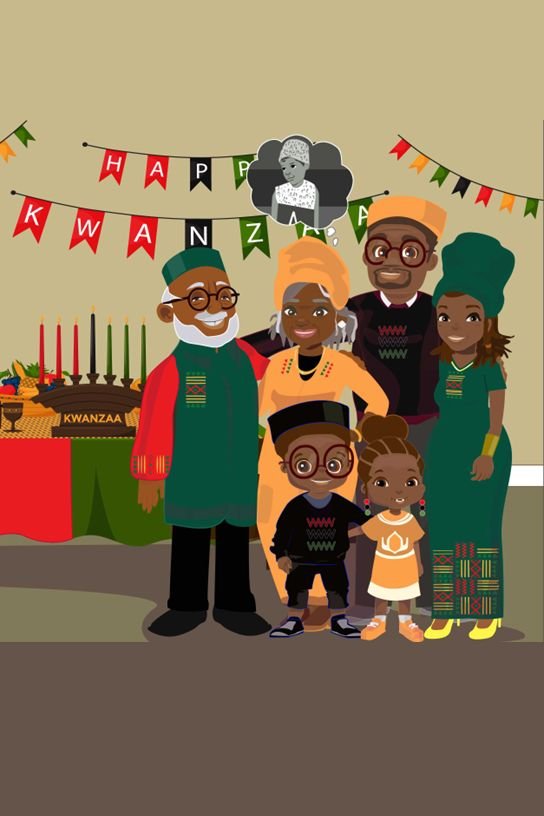
At the time, Kinamo Damu (Terri Bandele) was doing the best that a ten-year-old girl could do to protect her interests in holiday fun as her father, Ngao Damu (Sam Carr, Sr.) and Dr. Karenga discussed their objections to certain holiday practices. We introduce details about the Zep-Tepi / First Occasion of Kwanzaa as Kinamo and her two siblings they saw it through our "STEM 'n 'Nem" children's series in a story titled – "Kwanzaa, STEM, and the Seven Principles."
We share full details about the creation of Kwanzaa from their perspective in our "Kwanzaa FOR KIDS" story, which details events involving children from the Damu (Carr) family – Kinamo (Terri), Karama (Sam, Jr.), and Baraka (Tanya) from December 1965 leading up to the first Kwanzaa.
Also, in the "STEM 'n 'Nem" series, we add to our focus on increasing Black children and adult's S.T.E.M. proficiency by promoting increased principled practice through daily application of the Seven Principles. To make the connection to everyday practice more meaningful, our stories associate the Seven Principles with other Black occasions throughout the year, while also promoting accurate understanding of our history.
In summary, we believe a periodic renewal of our relationship with Kwanzaa and the Seven Principles is called for as we recognize the sixtieth anniversary of both traditions this year and next, and prepare for the continued growth and elevation through our culture that was envisioned when Kwanzaa was created. We further believe this renewal provides for the expanded perspective into African culture that is needed at this critical moment.
We thank Dr. Karenga for his vision, leadership, contribution, and work during the past six decades to create, maintain and promote Kwanzaa and the Seven Principles as cultural institutions, and for allowing other people to contribute to their growth and expansion. We also thank the people in the Us Organization who contributed in their own way to this communal holiday's creation and expansion.
We ask that you visit our https://kwanzaa.org and https://nguzosaba365.org websites to stay informed about our activities this year, and that you plan to join us online on Sunday, December 28, 2025 at 5pm PST for our annual Kwanzaa Celebration.
Please also reach us at contact@kwanzaa.org or contact@nguzosaba365.org for more info.