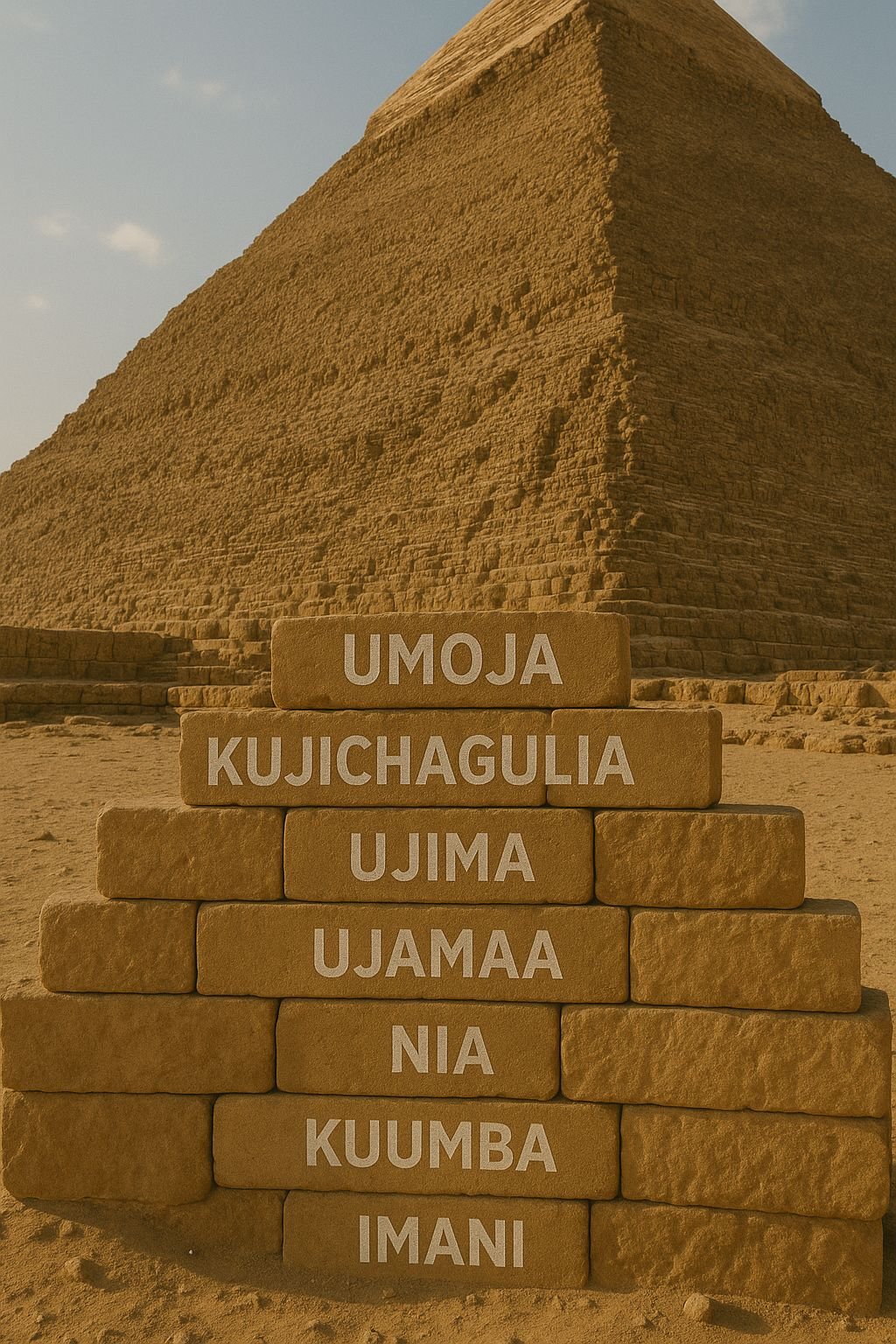
As we reach the sixtieth anniversaries of the Nguzo Saba (the Seven Principles) and the Kwanzaa holiday this year and next, we find ourselves facing conditions similar, in some ways, to those we faced in the 1960s when these cultural traditions were created.
At that time, Dr. Maulana Karenga and members of the organization, Us, looked at the material conditions in Black communities and responded with a long, hard look in the mirror. They decided that the first step toward changing those conditions in our favor was for the person looking in the mirror to improve their perception of – and relationship with – the person looking back at them, and with people who look similar.
Black people were, then, encouraged to study ourselves with the understanding that the solution to every problem we faced could be found within us and our ability to learn from, and reason with, our history and culture to find solutions to all the problems we face. They thought we needed to reconnect with a deeper and more meaningful understanding of who we are – and we did…
All these things were true in 1965, and they are true, as well, in 2025.
That's because, here, again, after sixty years of reconnecting with ourselves through a portal to African history and culture provided by Kwanzaa and the Seven Principles, Black people find ourselves, again, facing increasing oppression and decreasing opportunities in these United States. In this episode, politically unhinged oligarchs have overtaken politically compromised corporatists to further aggravate a failing system of exploitive capitalist greed with fascist chaos and digital control levers that select presidents, eliminate jobs, and maximize surveillance so people can be functionally disconnected for expressing the wrong opinion – or any opinion.
In response, and in our preparation for this sixtieth anniversary at The Afrikan Restoration Project, we followed the example set by Dr. Karenga and Us back in 1965 by looking at the material conditions of Black communities broadly, while considering our relationship to our culture here in 2025. We concluded that we face a new version of the same "cultural crisis" that threatened us in 1965 when Us responded by introducing the world to the Seven Principles and Kwanzaa.
This year, at The Afrikan Restoration Project, we decided to wrap ourselves in this sixtieth anniversary occasion by reconnecting with the original vision and inspiration for these two cultural institutions. Our purpose was to analyze our level of engagement with Kwanzaa and the Seven Principles to determine if we have gained all that we could from them, to then proceed in new and thoughtful ways, seeking deeper connections and lessons from these teachings and our culture more broadly.
I wrote about our pursuit of "The Zep-Tepi (First Occasion) of Kwanzaa" in my most recent article and our work in relation to it. From here, I will address our efforts to reconnect with the foundations of the Nguzo Saba / Seven Principles to assess our status relative to them, respectively, to develop strategies for our mission to expand their application beyond Kwanzaa. We believe the Seven Principles should be treated like a daily code of conduct – or a "Black job" – we are obligated to fulfill every single day.
With our assessment, we quickly realized a need for the Black community to improve it's standing related to all the principles. We also developed a deeper appreciation for the way the principles work in relation to each other, and how efforts to improve our engagement with any one of the principles benefits our engagement with every principle.
Umoja / Unity
The first principle – Umoja / Unity – is quite obviously the foundation and starting point of the Seven Principles and any collective effort. Surely, the limit of what we can accomplish together is based on the extent of our commitment to unity, and what that unity is based upon. Meaning, we can accomplish everything or nothing based on our unity and what that means.
We have struggled with unity in our communities for some time. I argue that it's because we haven't learned all the lessons to be learned from the Seven Principles, and have not yet applied them.
So, then, what are the lessons we have missed?
Some of the most significant lessons missed relate to Umoja / Unity and our pursuit of it. We have struggled to build unity around our shared history, skin color, or our race with limited success. Could it be that is the wrong criteria upon which to pursue unity – explaining, perhaps, why we haven't been as successful as we need to be with it? I believe that's possible.
In fact, I believe that through study of the Seven Principles and Kawaida philosophy more broadly, I finally understand why all Black people can't get along – and the answer is simply this; all Black people don't share the same values or the same goals going forward. Period. Without that there can be no unity. In fact, true unity only exists when people share the same values and goals. There is no other way.
The people who are winning run their winning operations that way. Their unity is based on shared values and goals. Nothing else. That's why they have certain Black people on their team to help them win against us. It's because they don't share our values. That is exactly what we mean when we say – "All skinfolk ain't kinfolk."
Kujichagulia / Self-Determination
As for the second principle – Kujichagulia / Self-Determination – we can improve a lot in terms of our self-determination because, collectively, we still have a lot to learn about ourselves. We can only become truly self-determined to the extent we understand ourselves. Meaning, we can only accomplish what we believe we are capable of.
The Honorable Marcus Garvey said it best – "People have done what people can do." With that, we recognize the need to continue learning more through our culture about what Black people have contributed to human history to become more fully self-determined in knowing and being committed to accomplishing everything we are capable of. We say, too, in our organization motto –
"What you'll do for yourself depends on what you think about yourself, and what you think about yourself depends on what you know about yourself. So, who are you, and what does that mean?"
Ujima / Collective Work and Responsibility & Ujamaa / Cooperative Economics
Our standing related to the third and fourth principles – Ujima / Collective Work and Responsibility and Ujamaa / Cooperative Economics – are related in the lessons we need to learn and apply starting TODAY for better outcomes during the next sixty years and beyond.
We need to do much more collective work to meet our responsibility for building a meaningful system of cooperative economics. We should acknowledge the work we have done and the relative success we have achieved in economics. But we must know there is much more work to be done to define and implement cooperative economic practices that meet our collective best interests.
That work begins with identifying, updating, and recreating models of cooperative economic excellence from African history and culture to create a system of commerce balanced in our interests. Those resources do exist, and there will be countless advantages in finding, adapting, and applying them going forward. We will share our findings in more detail this Kwanzaa season.
Nia / Purpose & Kuumba / Creativity
Our status with the fifth and sixth principles – Nia / Purpose and Kuumba / Creativity – is our best among all the principles. They are functionally related, too, because knowing our purpose directly affects our creativity. Operating in our purpose offers the greatest opportunity to express our highest creativity, and a lot of Black people are operating in our purpose individually. Collectively, I'm not sure we adequately understand our purpose. Meaning that too many of us don't act as if we know we are the people we have been waiting for.
The record shows the world follows Black people when we are at our best. We just need to reconnect with a deeper understanding of what that means, and become it to lead the way in creating the world we want to live in. A deeper connection with the Seven Principles and our culture more broadly will lead us to that outcome – becoming the best possible version of ourselves and inspiring the same in others.
Imani / Faith
Consistent with that, improving our standing related to the first six principles extends to our application of the seventh principle – Imani / Faith – where faith in not about believing in forces outside of ourselves, even as that practice is not dismissed. Faith in the Nguzo Saba is about having faith in ourselves and each other, and the principled practice that is required to establish and maintain it.
We could use more principled practice in the Black community to guide, inform, and elevate our ways. The Nguzo Saba / Seven Principles is poised to help continue providing the necessary "identity, purpose, and direction" to complete that task if we apply its teachings consistently.
If we do, we will look in the mirror one day soon to see the best possible version of ourselves looking back at us, with others then being inspired to follow – and become the best possible version of themselves, too…
We thank Dr. Karenga for his vision, leadership, contribution, and work during the past six decades to create, maintain and promote Kwanzaa and the Seven Principles as cultural institutions, and for allowing other people to contribute to their growth and expansion. We also thank the people in the Us Organization who contributed in their own way to this communal holiday's creation and expansion.
We ask that you visit our https://kwanzaa.org and https://nguzosaba365.org websites to stay informed about our activities this year, and that you plan to join us online on Sunday, December 28, 2025 at 5pm PST for our annual Kwanzaa event titled – "From Simba to Sedjemic Scientists and Engineers: Merging S.T.E.M. with the Seven Principles Going Forward to Elevate Blackness… and Everything Else."
Please also reach us at contact@kwanzaa.org or contact@nguzosaba365.org for more info.